This is Why I Call It the Homeless Industrial Complex
How a system meant to end homelessness became an industry that manages it instead.
Kevin Dahlgren — Jan 13, 2026
Abridged with the author’s permission. Edited for length only.
I subscribe to Kevin Dahlgren’s Substack, Truth on the Streets. His writing is consistently strong, and he reports from firsthand experience—giving him credibility on homelessness that few can match. Below is his latest publication.
The homeless industrial complex is a multi-billion-dollar system that thrives on homelessness. Governments, nonprofits, and contractors all get paid as the problem grows. Programs are measured by how many people they serve, not by how many actually exit homelessness. The result is a system that manages people instead of solving anything.
I worked in homelessness services for more than two decades. Anyone who believes this field is driven purely by compassion has never worked inside it.
Over time, that changed. The same individuals cycled through shelters year after year. Programs repeated themselves without accountability. When the public noticed and demanded results, leadership faced a choice: admit failure or change the story. They chose the story.
Homelessness was rebranded. Addiction, untreated mental illness, behavior, and personal responsibility quietly disappeared from the conversation. Responsibility evaporated, both for individuals and for the system itself. Homeless people were reframed as a permanent victim class. Empowerment was replaced with enabling, and enabling was profitable.
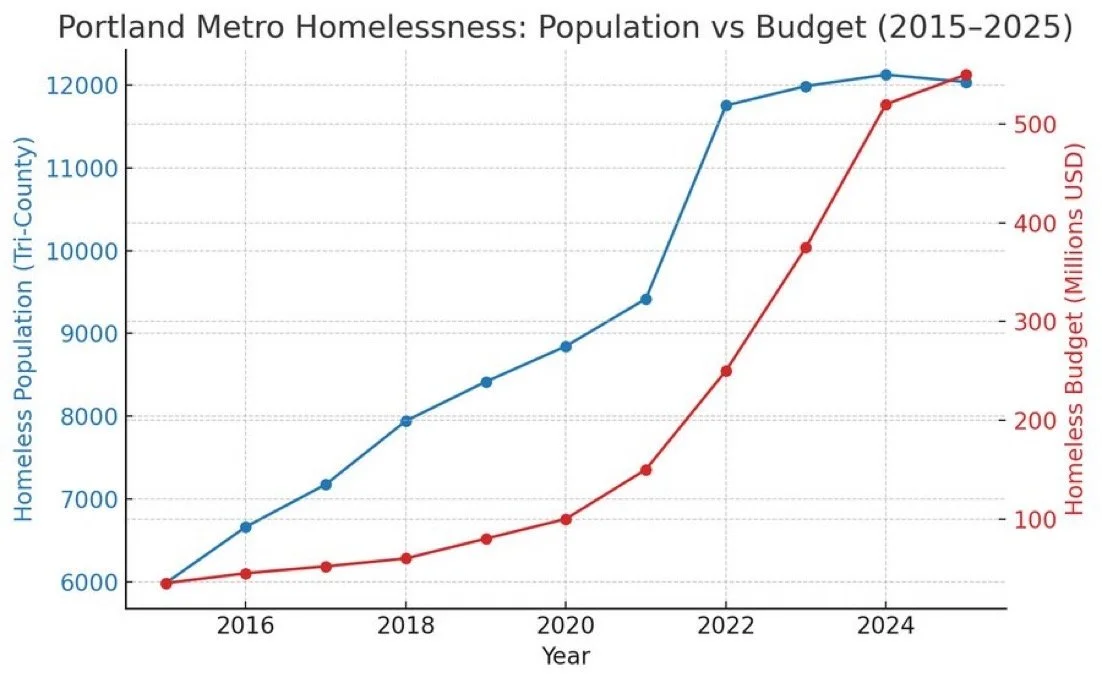
An eleven-year chart showing the increase in homelessness with a matching budget.
The data tells the story the rhetoric avoids. Over the past decade, homelessness has steadily increased while budgets have risen alongside it. In Portland, Oregon, the homeless population has surged by 61% in just two years, with more than 4,000 additional people now living on the streets. At the same time, Portland Metro’s homelessness budget has climbed to $724 million per year. Either way, one conclusion is clear—if money alone were the solution, this crisis would have been solved long ago.
Nonprofits became openly politicized. Ask for metrics and you were labeled “problematic.” Question outcomes and you were called “oppressive.” Suggest expectations and you were accused of cruelty. Dissent was no longer debated; it was punished. I know this firsthand.
Those who spoke up were targeted. Workers who questioned outcomes were pushed out. Contractors who raised concerns lost funding. Former insiders were smeared. This is how dissent was managed.
Despite the narrative shift, the public remained impatient and wanted results. Enter Housing First. Marketed as “evidence-based,” it is ideological in practice. Services are optional. Recovery is hoped for, not required. Visible homelessness briefly declined, but the system did not solve homelessness. It moved it indoors.
I worked inside a Housing First hotel. It was not stable. It was chaos: heavy drug use, violence, overdoses, death. Staff were discouraged, sometimes explicitly prohibited from offering proactive help because it supposedly created “power imbalances.” If the public saw what actually happens inside these buildings, the model would collapse overnight.
What exists today is not a homelessness response system. It is a self-protecting industry that converts human suffering into jobs, guaranteed budgets, political influence, and moral authority. Most large nonprofits are structurally incapable of success because their funding depends on homelessness continuing. Budgets grow when the problem grows. Failure is rewarded.
Homelessness is driven largely by severe addiction, untreated mental illness, trauma, and behavioral dysfunction. Housing alone does not fix this. Voluntary services do not fix this. Ideology does not fix this. Recovery requires structure. Stability requires expectations. Safety requires intervention. And intervention threatens the business model.
That is the conflict no one will admit. Ending homelessness would require confronting addiction, enforcing standards, mandating treatment in some cases, and measuring success by exits, not enrollments. The system is not designed to survive that level of accountability.
The unspoken rule is simple: homelessness must never actually end. People can be housed. Lives can be stabilized. But the crisis itself must remain—because it sustains budgets, careers, political alliances, and moral authority.
We face a choice. We can continue funding an industry that profits from permanent failure, or we can build a system that demands recovery, accountability, and real outcomes.
As long as homelessness is profitable, no one in power will fix it.
Kevin Dahlgren is a grassroots journalist documenting homelessness, addiction, and systemic failure on the West Coast. Through firsthand reporting, photography, and on-the-ground observation, he highlights the gap between public spending and real-world outcomes. His work humanizes people living on the streets while holding nonprofits, local governments, and policies accountable. Relying on direct encounters rather than press releases, he focuses on lived experience, public safety, and the consequences of failed interventions. Dahlgren challenges dominant narratives and advocates for practical, measurable solutions rooted in accountability and dignity.
To read more outstanding articles on homelessness by Kevin Dahlgren, subscribe to Truth on the Streets on Substack, by clicking here.