What Happens When One Party Runs a State Too Long? A Look at Homelessness
Homelessness does not become a crisis overnight. It builds over years through policy choices, public priorities, and the systems government creates or dismantles.
That raises a fair question: does long-term political party control of a state’s governorship affect homelessness outcomes?
I believe it does.
That should not be a radical claim. Governors shape budgets, appoint agency leaders, influence law enforcement priorities, and help determine how state systems operate. When the same party controls the governor’s office for multiple election cycles, its philosophy does not remain campaign rhetoric. It becomes embedded in law, funding, regulation, and program design. Over time, those decisions produce results.
To test that idea, I divided all 50 states and Washington, D.C. into three categories based on the last four gubernatorial election cycles: Blue states, Red states, and Purple states. Blue states were those where Democrats won all four cycles. Red states were those where Republicans won all four. Purple states were those with mixed control.
I then compared HUD’s Point-in-Time homelessness estimates from 2007 and 2024 and calculated each state’s homelessness rate per 10,000 residents. From there, I created a population-weighted average for each group so that large states carried appropriate weight and small states did not distort the results.
What the numbers show
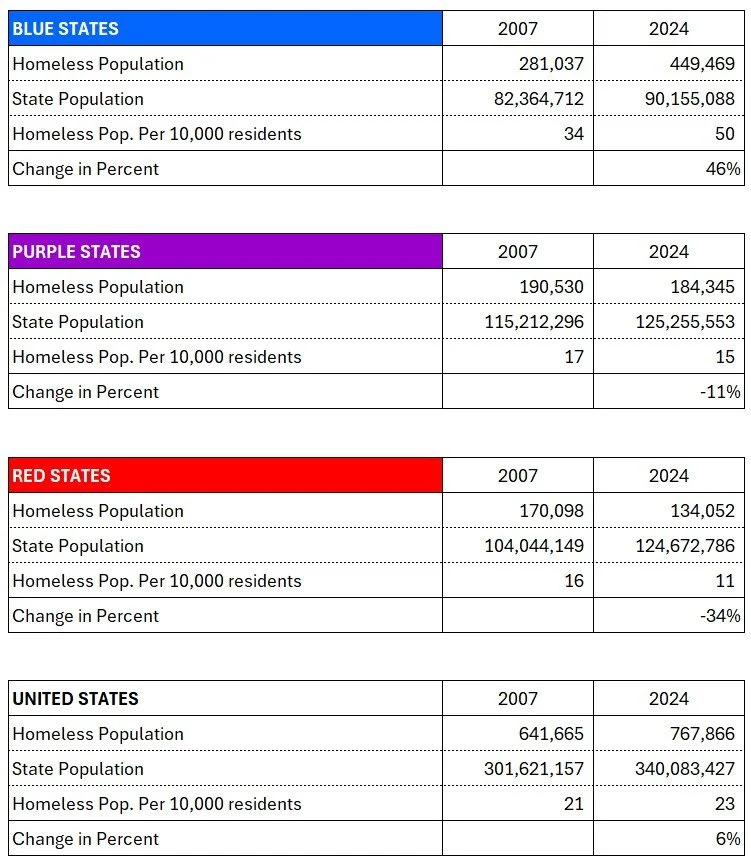
The pattern was hard to ignore.
States with Democratic governors over the last four election cycles had much higher homelessness rates per capita, and those rates rose sharply from 2007 to 2024. States with Republican governors over that same period saw an overall decline. Purple states landed in the middle.
That does not prove that one political party “causes” homelessness. Correlation is not causation. But that objection only goes so far. When a pattern is large, durable, and spans nearly two decades, it deserves serious attention. The claim here is not that party label alone explains homelessness. The claim is that long-term party control is strongly associated with different outcomes, and it is reasonable to ask whether different governing philosophies help explain that difference.
Three objections that do not fully explain the problem
Objection #1 - Homelessness is mostly about high housing costs.
Housing costs matter. Oregon has an affordability problem, and many Blue states include expensive coastal metro areas. But that explanation is not enough. If rent were the main driver, far more people would solve the problem the way struggling people usually do: by living with family or taking on roommates. The fact that so many remain unsheltered suggests something deeper is often going on. Many people living on the streets are not simply priced out. They are too unstable to live successfully with others without first being stabilized.
Objection #2 - Climate
The climate argument is not much better. If warm weather were the main explanation, then Florida, Texas, and Arizona would dominate the top of every homelessness list. They do not. Weather may influence where unsheltered homelessness is more visible, but it does not explain the major differences in outcomes between states.
Objection #3 - Correlation isn’t Causation
That is true, but it can also become a dodge. If long-term one-party control aligns with long-term differences in homelessness rates, it is fair to investigate whether policy differences are part of the reason. Ignoring that possibility because it is politically uncomfortable would be intellectually dishonest.
Oregon as a cautionary example
Oregon helps illustrate how policy choices can compound over time.
One major mistake was closing Dammasch State Hospital without creating adequate replacement capacity. That removed a major piece of Oregon’s inpatient psychiatric infrastructure. The result is visible today in a system that leaves too many severely mentally ill people cycling between the street, the emergency room, and jail instead of receiving sustained care.
Another problem has been the weakening of public-space enforcement. Even after the U.S. Supreme Court’s Grants Pass ruling removed a major federal obstacle to enforcing camping restrictions, Oregon cities still face additional state-law constraints. That has made enforcement more hesitant, more inconsistent, and less effective than it should be.
Then there is Measure 110. Oregon decriminalized hard-drug possession before it had a functioning treatment and accountability system in place. That was a serious mistake. The state removed consequences first and promised the treatment system would catch up later. It did not.
Oregon also weakened one of the few proven tools for moving high-risk addicts into treatment: leverage. When possession-based drug court pathways collapsed, so did much of the treatment-or-jail pressure that had pushed some people into recovery.
Add Oregon’s public defender crisis and narrow civil commitment standards, and the result is a state that too often cannot intervene effectively before vulnerable people spiral deeper into chronic homelessness.
Compassion without accountability is not compassion
Compassion matters. But compassion without accountability can turn into neglect. If a state reduces treatment capacity, weakens consequences for self-destructive behavior, narrows the ability to compel care, and makes public-space enforcement harder, it should not be surprised when homelessness worsens.
For years, Oregon and other like-minded states have embraced policies that reduce pressure, reduce accountability, and reduce consequences, while assuming that services alone will solve the problem. But many of the people most visibly trapped in homelessness are also trapped in addiction, mental illness, or both. They often need more than temporary shelter or a housing voucher. They need stabilization, supervision, treatment, and sometimes coercive leverage before lasting housing is realistic.
What should happen now
The lesson is not that party labels magically create homelessness. The lesson is that governance choices compound. Over time, they either strengthen the pathway back to stability or they weaken it.
If Oregon wants better outcomes, it needs to rebuild that pathway. That means more treatment capacity, including secure and inpatient options. It means restoring accountability tools that can compel engagement when warranted. And it means setting clear public-space standards and enforcing them consistently.
Homelessness is not a housing issue. It is not a compassion issue. It is a governance issue. And when governance fails for long enough, the consequences end up on the street.
For readers who would like to go deeper, the full position paper is available here: What Impact Does Political Party Control Have on Homelessness?