Holistic Recovery Organizations: What They Are and How HHF Evaluates Them
Seven years ago, when I founded Hope for the Homeless Foundation (HHF), I coined the phrase Holistic Recovery Organizations to describe nonprofits that provide transitional housing for individuals who are ready to rebuild their lives.
Holistic Recovery Organizations, or HROs, are not emergency shelters. They are structured, drug- and alcohol-free residential programs where participants agree to follow house rules, engage in recovery, and work toward long-term stability and permanent housing.
Key Characteristics of Holistic Recovery Organizations
1. Drug- and alcohol-free living environment
Residents are expected to remain clean and sober while participating in the program.
2. Transitional housing, not shelter
HROs provide a stable place to live while individuals work toward permanent housing.
3. Personal commitment to change
Participants have made a conscious decision to turn their lives around.
4. Accountability and house rules
Residents are expected to comply with program requirements, behavioral expectations, and standards of conduct.
5. Individualized case management
Each resident receives case management support, including a personalized recovery and stability plan.
6. Required participation
Following the recovery plan is not optional. Residents are expected to actively participate in the steps necessary to become stable.
7. Pathway to permanent housing
Once individuals are stabilized, the organization helps them secure permanent housing.
8. Measurable outcomes
HROs track program participation, completion rates, successful housing outcomes, and whether individuals remain stable and housed one year later.
How HHF Evaluates Holistic Recovery Organizations
HHF evaluates HROs using measurable outcomes, financial accountability, and each organization’s ability to help individuals address the underlying causes of homelessness, become stable, and transition into permanent housing.
Key Outcome Metrics
Each organization is asked to provide the following data for the year being evaluated:
Total number of persons served
Number of persons still in the program at year-end
Number of persons who exited the program, including those who left early and those who succeeded in becoming stabilized and housed
Success rate: total persons stabilized and housed divided by total persons exiting the program
One-year success rate: persons remaining stabilized and housed one year later divided by the previous year’s total number of persons stabilized and housed
Total annual residential program costs
Cost per person successfully stabilized and housed
Below is an example of these key metrics from a hypothetical nonprofit.
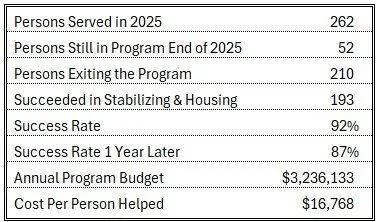
Program Summary
In addition to outcome data, HHF reviews each organization’s mission, structure, recovery model, and long-term accountability practices.
Each organization is asked to provide information on the following:
Mission statement
Year established
Origins of the organization
Governing body and organizational oversight
Program description
Top three causes of homelessness addressed by the program
Target populations served, such as men, women, women with children, youth, or other specific populations
Harm reduction policy, including whether medication-assisted treatment is opposed, allowed temporarily, or allowed long-term
Funding sources as a percentage of total revenue, including government, foundations, individuals, and other sources
Long-term tracking of program participants
Miscellaneous findings from onsite visits
Conclusion
HHF’s vetting process is built on a simple but important belief: good intentions are not enough. Organizations working with the homeless should be able to demonstrate that they are helping people move from crisis to stability, from dependency to responsibility, and from temporary shelter to permanent housing.
By focusing on measurable outcomes, one-year success rates, and cost effectiveness, HHF seeks to identify and support organizations that are not merely managing homelessness, but helping people overcome it. Holistic Recovery Organizations represent the kind of work HHF believes deserves greater recognition, greater support, and greater accountability.